
Impact: The Chief Marketing Information Officer at one new client wrote, “This technical overview made the difference in convincing my CTO and COO that we absolutely needed DS-IQ. I wish more vendors offered such clear descriptions of their products.”
Product: DS-IQ is a digital advertising platform that enables big box retailers to customize ad campaigns based on customer and situational data.
Sample: I wrote a functional overview targeting digital marketing executives and other technology and marketing decision makers.This sample is chapter 3 from that 20-page pre-sales document, which covered capabilities, architecture, and integration.
Contribution: I was the sole writer on the project.
3 Match a shopper’s moment with
DS-IQ Context services
DS-IQ Context services enable you to tailor direct advertising to fit a shopper’s experience in the moment. Context services provide localized, situational data points like school, weather, and sporting events. You combine these with personal and regional data to deliver the right message to the right customer at the right time.
Factors like weather, traffic, and local events change constantly. Your shoppers’ needs change with them. Kim in Dallas is suffering from hay fever just in time for his kids’ spring break. Carol in Buffalo has tailgating plans for Sunday with cold and snow coming her way. With Context services, you use these changes to create impactful consumer experiences.
Context services inform the other DS-IQ platform components when and where these different moments occur:
- Weather—hot, cold, snow, humidity, rain, hail, and severe weather warnings
- School dates—back to school, spring break, and end of school
- Traffic—heavy congestion and incidents
- Health—UV index, air quality, cold-cough-flu season, and allergy season
- Sports—NCAA, NFL, and MLB games
DS-IQ uses context in two ways:
- The Context Trigger service helps build an audience: Which shoppers are (or will be) experiencing an event?
- The Context Content service makes messaging more relevant: How do shoppers know this message is important to them?
Together the two Context services act as resources for other DS-IQ platform services, providing context as it’s needed. They are both Azure Windows services that gather the contextualized, relevant data on demand.
Context Trigger
The Context Trigger service identifies geographic areas that share a common experience or meet certain conditions in the moment. For example, it can list metro areas where there are upcoming NCAA football games or where forecasts predict rain. DS-IQ collects and constantly updates real-time contextual data and shares it to help build specific audiences.
Any DS-IQ service can request data from Context Trigger. The most common is the DS-IQ Targeting service, which is responsible for choosing audiences for campaigns.
The Targeting service asks Context Trigger for map areas that meet certain requirements. In response, Context Trigger retrieves the data and returns it to Targeting. Targeting uses the data in its calculation of the ideal audience for an ad.
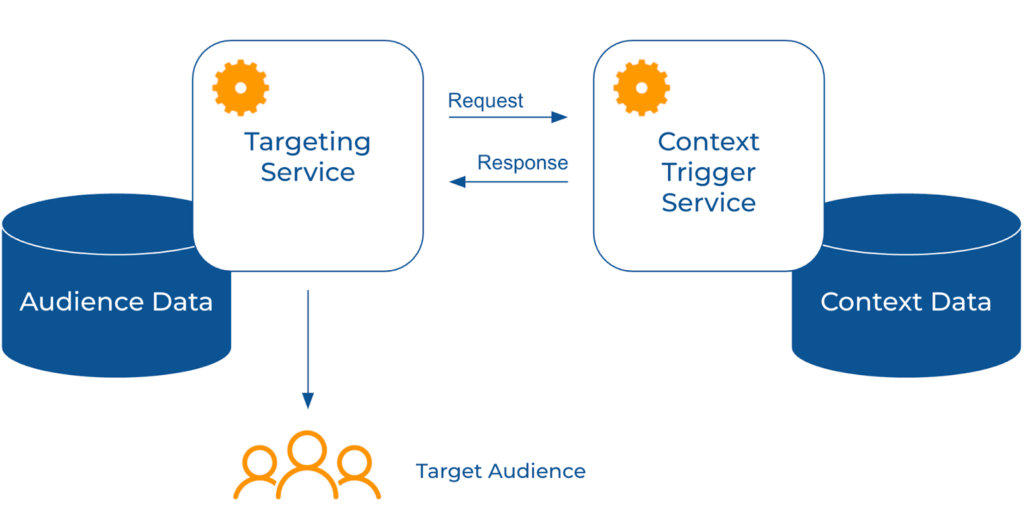
For example, suppose you want to define an audience for a marketing campaign centered on sun protection products. Targeting asks Context Trigger whether the UV index is currently at an unsafe level in California beach locales. Context Trigger responds that Malibu, Venice Beach, and Santa Monica all have dangerous UV levels predicted during the next week. Based on this response, Targeting defines the campaign audience as shoppers in those three locations.
These are the contextual situations that DS-IQ can use as triggers:
| Context | Trigger |
| Hot weather | Predicted temperature is at or above the hot threshold defined for the location |
| Cold weather | Predicted temperature is at or below the cold threshold defined for the location |
| Snow | Probability of snowfall is greater than 40% |
| Rain | Probability of rainfall is greater than 40% |
| Hail | Probability of hail is greater than 40% |
| Humidity | Atmospheric humidity index is above the high threshold defined for the location |
| Severe weather | Any type of severe weather warning has been issued |
| Back to school | School starts within 21 days |
| Spring break | Spring break starts within 21 days |
| End of school | School ends within 21 days |
| Heavy traffic | Congestion level is above the threshold defined for the location |
| UV index | UV index is at an unsafe level |
| Air quality | Air quality is at an unsafe level |
| Cold-cough-flu | A proprietary analysis of multiple factors indicates cold-cough-flu season is underway |
| Allergy | A proprietary analysis of multiple factors indicates allergy season is underway |
| NCAA football | An NCAA football game is scheduled within 14 days |
| Professional football | An NFL game is scheduled within 14 days |
| Professional baseball | An MLB game is scheduled within 14 days |
Context Content
Context can also enhance marketing and messaging content. The Context Content service provides contextual detail in the form of text. For example, it can deliver a predicted high temperature (103 degrees) or a back-to-school date and school name (September 3, Einstein Elementary).
Any DS-IQ service can request content from Context Content. The most common is the DS-IQ Messaging service, which is responsible for creating ad content. The Messaging service asks Context Content for details like the game day or team name. In response, Context Content retrieves the data and returns it to Messaging.
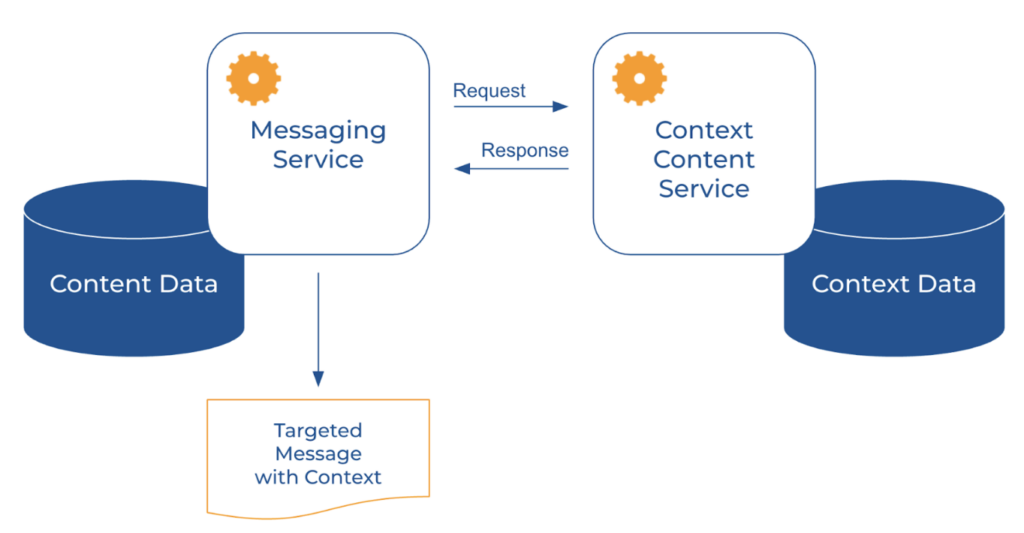
In our example using UV index to trigger a skin protection promotion, the message without context would simply read:
Protect your skin from damaging UV rays.
That’s okay. But by capturing the details of the context, you can increase the relevancy of the experience. This message contains text specific to the moment and location:
With a UV index of 7 in Malibu, be sure to protect your skin from the sun today.
To accomplish this, Messaging asks Context Content what the UV index is in Malibu. Context Content responds with 7. Messaging includes 7 and Malibu in the campaign text.
These are the contextual details that DS-IQ can provide for content:
| Context | Content |
| Hot weather | Predicted temperature |
| Cold weather | Predicted temperature |
| Snow | Snow probability % |
| Rain | Rain probability % |
| Hail | Hail probability % |
| Humidity | Humidity level % |
| Severe weather | A severe weather warning of any type has been issued |
| Back to school | Start date, school name |
| Spring break | Start date, school name |
| End of school | End date, school name |
| Heavy traffic | Congestion level |
| UV index | UV index level |
| Air quality | Air quality level |
| Cold-cough-flu | None |
| Allergy | None |
| NCAA football | Date and time, teams, venue |
| NFL football | Date and time, teams, venue |
| MLB baseball | Date and time, teams, venue |
Context changes everything
Each day, your customers take context into account in every purchase they make. It’s subtle, it’s local, and it’s time-sensitive. For individuals, this process is effortless and automatic. People expect it from themselves and one another. What they don’t expect is that a retailer could become a valued partner in making context-based decisions.
Context gives you trust-building superpowers. It changes the nature of interactions between you and your customers. You’re no longer blasting a product ad at them. Instead, you’re informing and helping them make smart shopping decisions. Your store feels local because you’re tuned into what’s happening in their home town. Your store feels personal because you know what they’re experiencing. Context makes your business relevant in shoppers’ lives.